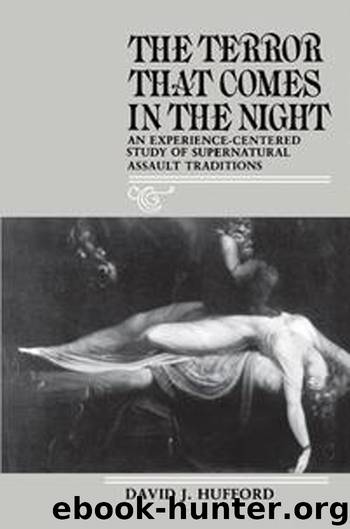
The Terror That Comes in the Night by David J. Hufford
Author:David J. Hufford
Language: eng
Format: epub
ISBN: 9780812292596
Publisher: University of Pennsylvania Press
Philomates: Is it not the thing which we call the Mare, which takes folkes sleeping in their beds, a kinde of these spirits, whereof ye are speaking?
Epistemon: No, that is but a natural sickness, which the Mediciners have given that name of Incubus unto, ab incubando, because it … makes us think that there were some unnatural burden or spirit, lying upon us, and holding us down.25
Jones uses this passage to support his contention that just when people were beginning to emancipate themselves from the belief in hallucinated beings in connection with erotic dreams and retaining the belief only in connection with nightmares, a theological elaboration of the incubus concept reanimated the ancient belief that the partner in a sexual dream was an actual being.26 A more reasonable interpretation is that even though popular tradition included two relatively distinct categories, academic writers had already begun to confuse them by the application of a popular term for one category to the official explanation of the other.
A major medieval school of thought held that some or all nocturnal sexual encounters with “supernaturals” were in fact dreams.27 Some of the debate about witchcraft focused on whether submission to an incubus was sufficient evidence that a woman was a witch. Those who held the dream explanation exclusively argued that this was an imaginary experience and could not constitute evidence. The incubus question was a part of the larger debate on whether witchcraft genuinely involved preternatural acts and powers or whether its primary crime was heresy. The issue was officially settled in favor of the preternatural theory by 1486, when Heinrich Kramer and Jakob Sprenger published Malleus Maleficarum (The Hammer of Witches), a detailed manual used extensively during the witch hunts. In the section headed “Here follows the Way whereby Witches copulate with those Devils known as Incubi,”28 the authors made it abundantly clear that they were exclusively concerned with overtly sexual experiences and that they considered such experiences to be diabolical.
Segments of both popular and academic society, then, were familiar with at least three types of nocturnal experience: a variety of dreams, sexual encounters with “supernaturals” sometimes called incubus or succubus depending on gender, and attacks of the Old Hag type without any obvious sexuality. Opinion differed concerning the cause and the objective reality of the latter two, as it currently does in Newfoundland in connection with the Old Hag. The word “incubus” was sometimes extended to include the Old Hag type of experience, especially among physicians, probably on the basis of the feeling of pressure often associated with the attacks. In general usage, the word kept its strong sexual connotations. The word “nightmare” and its cognates tended to retain a more limited meaning involving paralysis and pressure.
Because of his assumption that the two types of experience are identical at an unconscious level, Jones overlooked the possible significance of phenomenological differences and omitted information about the contents of the incubus experience. The presence of sexual connotations was sufficient information from his perspective. By his
Download
This site does not store any files on its server. We only index and link to content provided by other sites. Please contact the content providers to delete copyright contents if any and email us, we'll remove relevant links or contents immediately.
| Ancient & Controversial Knowledge | Ghosts & Hauntings |
| Hermetism & Rosicrucianism | Magic Studies |
| Occultism | Parapsychology |
| Supernatural | UFOs |
| Unexplained Mysteries |
Animal Frequency by Melissa Alvarez(4478)
Sigil Witchery by Laura Tempest Zakroff(4250)
Real Magic by Dean Radin PhD(4134)
Fingerprints of the Gods by Graham Hancock(4009)
Aleister Crowley: The Biography by Tobias Churton(3647)
Journeys Out of the Body by Robert Monroe(3630)
Alchemy and Alchemists by C. J. S. Thompson(3526)
The Rosicrucians by Christopher McIntosh(3523)
Mysteries by Colin Wilson(3460)
The Hatha Yoga Pradipika (Translated) by Svatmarama(3353)
Hitler's Monsters by Eric Kurlander(3352)
Wicca: a guide for the solitary practitioner by Scott Cunningham(3182)
John Dee and the Empire of Angels by Jason Louv(3170)
Infinite Energy Technologies by Finley Eversole(2989)
Book of Life by Deborah Harkness(2943)
Dark Star Rising by Gary Lachman(2872)
The Book of Lies by Aleister Crowley(2849)
Aliens by Jim Al-Khalili(2837)
To Light a Sacred Flame by Silver RavenWolf(2828)
